





The Vienna Doctoral School of Social Sciences promotes innovative, excellent, problem-oriented research that aspires to contribute to societal debates and address key global challenges.

The cohorts trained and supported by the ViDSS are part of a vibrant research environment and international networks. The ViDSS encompasses and fosters connections between a broad range of disciplinary, interdisciplinary and transdisciplinary perspectives. The ViDSS embraces the entire range of epistemological, methodological and theoretical approaches that are employed at the Faculty of Social Sciences. Doctoral candidates receive research training and write a doctoral thesis in the fields of communication, demography, development studies, nursing science, political science, science and technology studies, social and cultural anthropology, and sociology. The ViDSS aims for the highest standards in doctoral training and close supervision to ensure a mastery of social scientific debates and relevant theories and methods. As a result, ViDSS graduates are highly employable both within and outside academia.

Fellowship and award winners
 

Elif Gül, ViDSS student in science and technology studies, was awarded the Johanna-Dohnal-Förderpreis by the Johanna Dohnal Archive for her doctoral thesis project on the material-semiotics of obstetric violence. The award honours authors of outstanding dissertations that promote gender democracy and equality, and serve as role models for women in education. Congratulations!

Fellowship and award winners
 

Michaela Forrai, Alexandra Wölfle, Thomas Kirchmair and Aleksandra Lazić won the Klaus Schönbach Award 2025 of the Department of Communication. The award aims to support doctoral candidates and postdoctoral researchers in pursuing, refining and enhancing their own international lines of research.

Fellowship and award winners
 

We warmly welcome our new sowi:docs Fellows! Léa Dudouet (science and technology studies) will explore the sociotechnical meanings of fertility tracking and reproductive decision-making in Austria. Clara Lerch (communication) will investigate how political and media discourse influences public perception and policymaking in three European Member States.

Blog
 

(by Alice Vadrot, Emil W. Hildebrand, Carolin Hirt, Wenwen Lyu, Felix Nütz, Hristina Talkova)

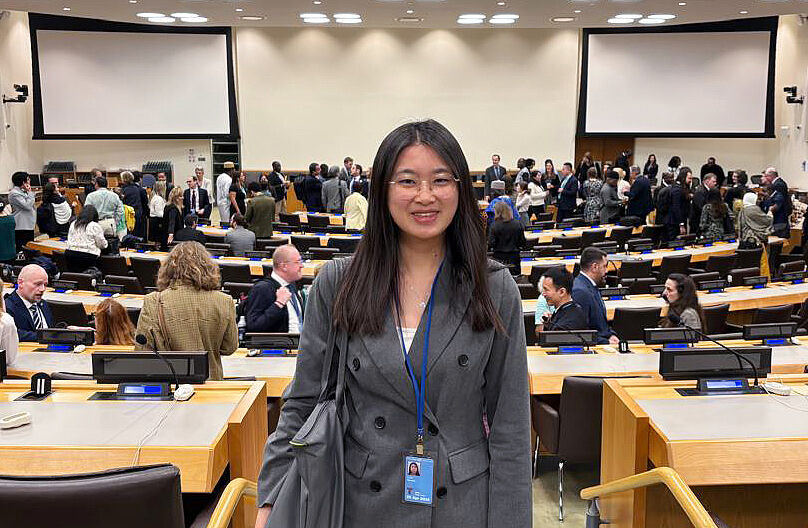
Kingston, Jamaica. July 2025. The tickets to Jamaica were already booked, the US transit visa secured, and a field note outline meticulously prepared. Then the news broke: academics and civil society actors would be barred from fully accessing this year’s Council Meeting of the ...

Radio and podcast
 

Felix Maile and Dorota Vargová provide insights into their experiences with archives and data bases. Learn about the extraordinary lengths they had to go to chase primary sources, which ethical questions they have to deal with and why they are not using any AI tools for their analyses.

Media articles and press releases
 

A recent publication by ViDSS Student Carolin Hirt (co-authored with Alina Brad, Etienne Schneider, Christian Dorninger, Willi Haas, Dominik Wiedenhofer and Simone Gingrich) reveals that climate policy in Austria focus on efficiency improvements and technological alternatives. Measures aimed at directly reducing emissions-intensive demand remain largely untapped. (In German)

Fellowship and award winners
 

Communication scientist, ViDSS Alumna and former sowi:doc Fellow Selina Noetzel received one of the 40 Awards of Excellence (Staatspreise für die besten Dissertationen) for her doctoral thesis “Why am I seeing this? Cognitive, attitudinal, and behavioral effects of online political microtargeting”. Congratulations!

Blog
 

(by Jule Kegel)

When asked about their views on politicians, the British public does not hold back. Eight in ten Britons agree that the gap between ordinary people and politicians is wider than the differences among ordinary people. The same proportion say that MPs in Parliament ...

Media articles and press releases
 

Together with Ulrike Zartler and Lena Grabner, sociologist Vera Dafert presents the project “How 2 Survive A Pandemic” which investigates how the Covid-19 pandemic and the resulting lockdowns changed the daily lives of youth and the competencies they developed to overcome this crisis. (In German)

New publications by ViDSS students

Showing entries 21 - 40 out of 133
No room in the North: housing scarcity as infrastructure’s failed relations in the Arctic. / Schmid, Katrin; Adams, Ria-Maria.
In: Polar Geography, 03.12.2025.

Publications: Contribution to journalArticlePeer Reviewed


Die strukturellen Grenzen des Dekarbonisierungsstaates. / Brand, Ulrich; Hausknost, Daniel; Brad, Alina et al.
In: PROKLA. Zeitschrift für kritische Sozialwissenschaft, 02.12.2025.

Publications: Contribution to journalArticlePeer Reviewed


Temporality of Arctic transport infrastructure: bridging seasonal supply in Egvekinot, Chukotka. / Davydova, Elena; Povoroznyuk, Olga.
In: Polar Geography, 01.12.2025, p. 1-20.

Publications: Contribution to journalArticlePeer Reviewed


Listen to me! Target perceptions of digital hate: A scoping review of recent research. / Khaleghipour, Maryam (Corresponding author); Koban, Kevin; Matthes, Jörg.
In: Trauma, Violence, & Abuse, Vol. 26, No. 5, 12.2025, p. 1082-1096.

Publications: Contribution to journalArticlePeer Reviewed


Making critical raw materials from a multi-scalar perspective: The case of lithium in the European Union. / Eyselein, Gabriel; Dorn, Felix Malte.
In: Geoforum, 12.2025.

Publications: Contribution to journalArticlePeer Reviewed


Think twice, scroll once: Encouraging critical reflection as a shield against health misinformation and overgeneralized messaging by social media influencers. / Kanková, Jaroslava; Matthes, Jörg.
In: Computers in Human Behavior, Vol. 177, 108896, 04.2026.

Publications: Contribution to journalArticlePeer Reviewed


Report on young people's preferences. / Lähdesmäki, Tuuli; Hiltunen, Kaisa; Sarikakis, Katharine et al.
The REBOOT Project (Reviving, Boosting, Optimising and Transforming European Film Competitiveness – REBOOT), funded by the European Union's Horizon Europe Research and Innovation programme under Grant Agreement No. 101094769.. 2025.

Publications: Other publicationOther


Hostile legacy media, friendly social media? Exploring young people’s use, trust, and bias perception of different news sources about the Middle Eastern conflict. / Wölfle, Alexandra; Schmuck, Desiree.
In: International Journal of Communication (IJoC), Vol. 19, 26.11.2025, p. 3808–3832.

Publications: Contribution to journalArticlePeer Reviewed


Not so ephemeral after all. Longitudinal associations between emerging adults’ engagement with ephemeral social media features, production stress, and social capital. / Forrai, Michaela; Koban, Kevin; Matthes, Jörg.
In: Cyberpsychology : Journal of Psychological Research in Cyberspace, Vol. 19, No. 5, 1, 24.11.2025.

Publications: Contribution to journalArticlePeer Reviewed


Pacing Space: Futuring Practices and Temporal Ownership in the European Space Sector. / Klimburg-Witjes, Nina; Kürten, Philipp.
In: Science and Public Policy, 24.11.2025.

Publications: Contribution to journalArticlePeer Reviewed


„Nomen est omen“: Was Namen mit Vorurteil und Diskriminierung zu tun haben. Holzinger, Clara (Interviewee). 2025. Ö1 Moment.

Publications: Electronic/multimedia outputRadio show


Young Adults’ Folk Theories in a Fragmented Journalistic Environment. The Case of Italy. / Garusi, Diego; Splendore, Sergio .
In: Journalism Practice, 16.11.2025.

Publications: Contribution to journalArticlePeer Reviewed


Resource or crisis? Cognitive functioning after widowhood and why paid work status matters. / Cabaraban, Maria Karlene Shawn I; Bordone, Valeria; Weber, Daniela.
In: The journals of gerontology. Series B, Psychological sciences and social sciences, 13.11.2025.

Publications: Contribution to journalArticlePeer Reviewed


Flying into Frictioned Futures: Development of Canada’s Northernmost Runways. / Schmid, Katrin.
In: Anthropologica, 12.11.2025.

Publications: Contribution to journalArticlePeer Reviewed


A double-edged sword: Exploring associations between engagement with mental health content by social media influencers and psychological well-being. / Kanková, Jaroslava; Vranken, Sofie; Matthes, Jörg.
In: Cyberpsychology : Journal of Psychological Research in Cyberspace, Vol. 19, No. 5, Article 2, 11.2025.

Publications: Contribution to journalArticlePeer Reviewed


Predicting the intention to use generative AI for health information: Comparative survey model. / Matthes, Jörg; Reinhardt, Anne; Hodzic, Selma et al.
In: Journal of Medical Internet Research, 11.2025.

Publications: Contribution to journalArticlePeer Reviewed


An Agent-Based Model of Online Protest and Repression in Authoritarian Settings. / Kulichkina, Aytalina; Waldherr, Annie; Wijermans, Nanda.
Advances in Social Simulation. Springer, 2025. p. 305-319.

Publications: Contribution to bookContribution to proceedingsPeer Reviewed


From sparks to action: The role of political influencers for young adults' political efficacy and political participation in Austria, Hong Kong, Indonesia, and Serbia. / Munzir, Atika Aisyarahmi; Neureiter, Ariadne; Matthes, Jörg et al.
In: Frontiers in Political Science, Vol. 7, 1620631, 16.10.2025.

Publications: Contribution to journalArticlePeer Reviewed


It's true, but still harmful: Examining the effects of overgeneralized health messages by social media influencers using two pre-registered experiments. / Kanková, Jaroslava; Binder, Alice; Matthes, Jörg.
In: Journal of health communication : international perspectives, 09.10.2025.

Publications: Contribution to journalArticlePeer Reviewed


Showing entries 21 - 40 out of 133